


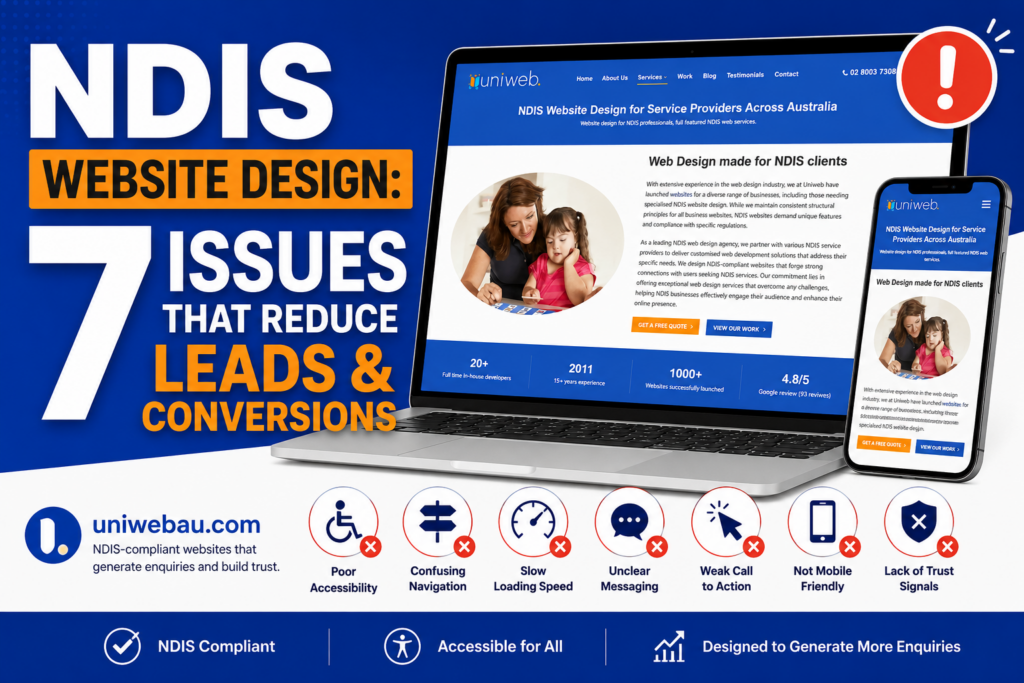
The market for the National Disability Insurance Scheme (NDIS) has passed a significant milestone. With 21,734 NDIS-approved service providers offering support to over 761,442 participants within the $45 billion NDIS marketplace, the market for participant recruitment has never been more competitive.However, the majority of websites run by NDIS service providers are actively turning away applicants — due to poor design, lack of trust signals, inaccessible layouts, and compliance gaps that immediately raise concern with eligible participants and the NDIS Quality and Safeguards Commission.
Your website will be far more than an ordinary promotional tool in 2026. Support coordinators will assess you through it before they ever get in touch. Participants and families will review it to determine how much they trust you with their supports. And in accordance with the new continuous compliance monitoring model, the NDIS Commission may visit your website at any time.
The seven major website design problems that will have a negative effect on your NDIS service provider lead and conversion are highlighted in this blog, along with a simple, workable fix for each problem.
The lack of appearance is not the reason most NDIS provider websites fail. They fail because of the uncertainty they create in participants and coordinators — and uncertainty kills enquiries.

Why Your NDIS Provider Website Directly Impacts Lead Volume
Many NDIS providers still view their websites as digital brochures meant for people who already know them. This thinking is outdated and costly. Over 80% of participant enquiries in 2026 will begin with a Google search. Families searching for “NDIS Support Worker Sydney” or “SIL Provider Melbourne” are already ready to make contact — but only if they find a compelling reason to do so.
Uniweb has built websites for NDIS providers across Australia — from Sydney and Parramatta to Melbourne, Brisbane, Perth, and Wollongong. Across every market, the same seven issues consistently undermine NDIS provider websites. Here they are — with a clear, actionable fix for each one.
No WCAG Accessibility Compliance
The majority of NDIS provider websites lack proper accessibility for users with disabilities. NDIS Accessibility Standards (WCAG 2.1) require that all NDIS websites be keyboard-friendly, screen reader-readable, have appropriate colour contrast, descriptive image alt text, correctly labelled forms, and closed captions for any video content. An inaccessible website tells future clients and their families that your digital presence was built without regard for the very people you serve — precisely the opposite impression an NDIS provider should make. With new digital accessibility requirements being introduced in Australia in 2026–2027, non-compliant sites also face increasing legal exposure.
For a deeper look at how accessible design drives both compliance and conversions, see our article on must-have website features for NDIS service providers.
- Test your site with free tools like WAVE by WebAIM or Google Lighthouse to identify accessibility failures
- Ensure every image has precise, descriptive alt text — not just “image” or the filename
- Verify colour contrast ratios meet the WCAG 2.1 AA minimum (4.5:1 for body text)
- Attach correctly labelled fields to every form input — placeholder text alone is not sufficient
- Add captions to every video on your website
- Publish an Accessibility Statement page outlining how your website satisfies WCAG requirements
Weak or Missing Calls to Action
A visitor lands on your NDIS website. They read through your services. They like what they see. And then — nothing. No clear next step. No visible phone number. A “Contact Us” link buried in the footer navigation. This is one of the most common and most damaging issues on NDIS provider websites, and it directly kills conversion rates.
Participants and families are often navigating complex emotions, time pressure, and decision fatigue when researching providers. If your website doesn’t make it immediately and obviously clear what they should do next, they will simply close the tab and go to a competitor whose website made it easier.
This applies equally whether you’re serving participants in Sydney, Melbourne, or Brisbane — the CTA problem is universal and equally costly in every market.
- Place a prominent CTA button (“Book a Free Consultation” or “Make an Enquiry”) in the header — visible on every page without scrolling
- Include a clickable phone number in the top right of every page
- Add a short enquiry form directly on the homepage — not only on the Contact page
- Use action-oriented language: “Get in touch today to discuss your needs” outperforms “Contact Us”
- Include a CTA at the bottom of every service page and every blog post
- Consider a “Request a Callback” form for visitors who prefer not to call directly
No NDIS Registration Number Displayed
While this may appear to be a small detail, it carries significant weight. Your NDIS Registration Number should appear in the footer of your website — visible on every page — so participants and coordinators can immediately verify your legitimacy without needing to search the NDIS Provider Register separately.
When a registered provider does not publicly display their Registration Number, it can appear untrustworthy. Support Coordinators managing numerous participants have little time to investigate each provider and will quickly move on to one that demonstrates legitimacy clearly. In 2026, with the NDIS Commission operating in continuous monitoring mode, displaying your Registration Number also acts as a positive signal to auditors.
- Add your NDIS Registration Number to the footer — it must be visible on every single page
- Include it on your homepage in the “About Us” or provider overview section
- List your specific registered service categories alongside your Registration Number
- Link directly to your listing on the NDIS Provider Register so coordinators can verify instantly
- If you provide services across multiple states, include Registration Numbers for each state
Slow Load Speed and Poor Mobile Experience
The majority of participants, carers, and support coordinators are searching for NDIS providers on their phones. If your website is not mobile-friendly, you are actively losing clients. Google gives preference to mobile-friendly websites in its rankings, and a page delay of just three seconds can increase bounce rates by over 50%.
Many NDIS provider websites are built on outdated templates, loaded with oversized unoptimised images and too many plugins — all of which cause slow page loads and user frustration. A slow mobile experience signals to families making sensitive care decisions that your organisation lacks attention to detail. This is just as critical in Parramatta as it is in Perth or Wollongong — mobile users across all markets are equally impatient.
- Test your speed with Google PageSpeed Insights — aim for 90+ on mobile
- Compress and resize all images before uploading (WebP format recommended in 2026)
- Use a caching plugin and CDN if you’re on WordPress — our WordPress developer team configures both as standard
- Ensure your site uses fully responsive design — layouts that adapt naturally to all screen sizes
- Make all buttons, menus, and form fields large enough for easy tapping on mobile
- Use quality Australian-based hosting to reduce server response times for local visitors
Vague Service Pages With No Location Targeting
The services offered by providers in the National Disability Insurance Scheme (NDIS) are localised. A person looking for assistance from an NDIS provider will not search for General ‘Disability Support’. Rather they will look for an NDIS support worker in the Inner West of Sydney or a Supported Independent Living (SIL) provider in Brisbane’s northern districts. A generalised NDIS (e.g ‘NDIS Provider’, ‘NDIS Support Services’, etc) service page that does not include geographic information (or geographic targets) will fail to attract potential clients or Google listings relevant to localised searches.
Most NDIS provider websites contain a generic services page without reference to specific suburbs/postcodes and therefore will be unable to rank on Google for those searches. In order for Google to deliver relevant search results, you must provide it with geographic signals which will enable them (in part) to create an appropriate search result for location-specific queries. If you do not, you will not be listed in the search results. This holds true regardless of whether you are targeting clients in Sydney, Melbourne, Brisbane, or Perth.
- Create individualised service pages for your main services (i.e. ”Daily Living Support Sydney”, ”SIL Brisbane” etc.).
- Include your service suburbs/regions as a natural part of the content on each of these pages.
- Create location-targeted landing pages for each of your most valuable service areas.
- Build a page titled “Areas We Service” that lists every suburb and postcode in your service area.
- Optimise your Google Business Profile with your service area — this drives local map pack visibility
- Use schema markup (LocalBusiness schema) to help Google understand your location and service areas
Your NDIS Provider Website Has No Trust Signals or Social Proof
Choosing an NDIS provider represents one of the most emotionally important decisions a family can make. A participant or their carer will trust their provider to provide a safe, supportive, and caring environment for them each day. Trust is essential; yet, most NDIS provider websites do very little to actively establish and build that trust.
If there are no testimonials or team members associated with the site, as well as no Google reviews or case studies for potential customers to see and read about, the site will likely feel clinical and cold; thus, creating a trust gap to all potential customers regardless of their location (i.e., from a Sydney metro to a Wollongong regional provider). Therefore, your website must create warmth and credibility similar to that of a personal referral source.
For a complete overview of what features your NDIS website needs to build trust at scale, and for ideas on supporting your digital presence with broader marketing, explore our social media marketing and Google Ads management services.
- Include honest testimonies from participants and carers, complete with first names, appropriate photographs, and specific results.
- On your homepage and service pages, prominently display your Google rating and review count.
- Add official team photos that are current and authentic rather than stock photos.
- Provide team bios that include credentials, experience, and any applicable professional registrations.
- Showcase any awards, accreditations, or peak body memberships (e.g. NDS, ACSA)
- To humanise your company, provide a brief “Meet the Team” film or founder introduction.
Prohibited or Misleading Content
This issue doesn’t just reduce leads — it creates serious compliance risk. Guaranteed outcome claims must not appear anywhere on your website. Statements like “we will improve your child’s communication skills” or “our support workers guarantee participant independence outcomes” are prohibited. The NDIS funds supports, not outcomes, and advertising that implies guaranteed results misrepresents the nature of NDIS-funded services.
Misleading claims about registration status, service areas, or participant cohort also create audit risk. If your website says you operate nationally but your registration is limited to one state, that is a red flag the Commission will identify. In 2026, with continuous monitoring now active, your website content is live evidence — not just marketing copy.
- Replace all outcome guarantees with accurate capability statements: “our OTs are experienced in supporting participants with autism to develop communication skills” is compliant and still compelling.
- Ensure your stated service areas exactly match your actual NDIS registration and operational capacity.
- Do not claim NDIA endorsement or government backing beyond what is accurate.
- Review all website copy against the NDIS Code of Conduct and Australian Consumer Law.
- Have a compliance-aware professional or consultant review your content annually — especially after any Commission policy changes
- Keep your site’s service category descriptions precisely aligned with your registered support categories
The NDIS Quality and Safeguards Commission has shifted to continuous compliance monitoring in 2026. Your website can be reviewed at any time — not just during scheduled audit cycles. Treat your website as compliance infrastructure, not just a marketing tool. Review our NDIS website design service to see how we build compliance into every provider website we build.
Your NDIS Provider Website Fix Checklist
Use this checklist to audit your existing NDIS provider website or brief a web designer on what needs to be built correctly from the start:
- WCAG 2.1 AA accessibility compliance — tested with WAVE or Lighthouse
- Clear, visible CTA on every page — phone number in header, enquiry form on homepage
- NDIS registration number displayed in footer and homepage
- Mobile-first responsive design with page speed score of 90+ on Google PageSpeed
- Dedicated service pages with location-specific content and suburb targeting
- Genuine testimonials, team photos, and Google review score displayed prominently
- All content reviewed for compliance — no guaranteed outcomes, accurate service areas
- Google Business Profile optimised with service areas and correct NAP details
- An NDIS Information page explaining how participants can access your services
- Schema markup (LocalBusiness) configured for local search visibility
How Uniweb Can Help
We build high-performance, accessible WordPress websites for NDIS providers throughout Australia — designed for accessibility compliance, local SEO, and genuine lead generation. We also offer search engine optimisation and social media marketing and Google Ads management to help NDIS providers grow their digital presence beyond just the website. View our portfolio, read our web design blog, or contact us today for a free consultation.
Is Your NDIS Website Costing You Leads?
Uniweb creates accessible, WCAG-compliant WordPress websites for Australian NDIS providers — built to increase participant enquiries, strengthen trust, and meet industry compliance standards.
Request a Free NDIS Website Assessment →