


As an NDIS provider, you have to manage everything from compliance, care plans, communication with participants and team coordination simultaneously! AI is no longer something only enterprise IT departments use – it’s now being used by many smaller and medium-sized NDIS providers all over Australia as a practical tool to save them time each week and provide improved outcomes for their participants.
Why NDIS Providers Are Turning to AI
As of 2026, the National Disability Insurance Scheme has over 660,000 active participants, which presents both an opportunity for service providers and significant administrative pressure. Compliance with NDIS Practice Standards, audit trails, service agreements, progress notes, and rostering create a burden on staff to provide direct support to clients.
Providers are required by the NDIS Quality and Safeguards Commission to prove that they provide safe support that is compliant with registered practice standards, and this documentation demand is where AI tools can assist providers most.
The great news is that you do not need large budgets or an internal IT department to start utilising these tools. Most AI tools available today are affordable, web-based, and aimed at smaller organisations. By using these tools alongside a well-developed custom NDIS web design, your online presence will reflect the efficiencies you are achieving behind the scenes.
1. AI-Powered Documentation and Progress Notes
One of the most time-consuming parts of delivering NDIS services is writing progress notes. Support workers have to write clear, consistent notes for each shift and in accordance with NDIS Practice Standards. AI writing assistants — including Microsoft Copilot as well as specialised care management platforms — can convert audio recordings or simple prompts into clear and compliant notes in a matter of seconds.
2. AI Chatbots for Participant and Family Communication
Many families and participants will have questions after business hours: What’s my next support session? How do I change my service agreement? Can I have a different support worker? An AI-based chat function on your website can help answer these questions 24/7 and identify more complex questions before sending them to the appropriate staff member during business hours.
This is not aimed at replacing your staff but at making your organisation more accessible after hours. A chat function helps reduce inbound calls regarding repetitive FAQs while maintaining quality of service for participants and families.
💡 Real-World Impact
NDIS providers who implemented website chatbots report a 30–40% reduction in routine enquiry phone calls, allowing coordinators to dedicate more time to intake, reviews, and participant planning meetings. A strong web presence backed by the right features starts with the right design partner — explore Uniweb’s NDIS website packages built specifically for Australian providers.
3. Automated Rostering and Scheduling
Finding the ideal support worker for each of your participants at the right time can be difficult given factors including qualifications, transport limitations, participant preferences, and leave. AI-based scheduling systems such as Humanforce and Deputy use algorithms to produce the best possible schedule, identify potential conflicts, and notify coordinators of shortages before the need arises.
Key capabilities to look for:
Smart Auto-Scheduling
Automatically fills open shifts based on worker availability, skills, and participant preferences.
Mobile Notifications
Push alerts to support workers and participants about confirmed, changed, or cancelled sessions.
Budget Tracking
Real-time visibility into participant plan budgets so you never accidentally exceed funding limits.
Incident Alerts
Flag incidents at the point of shift completion to keep your compliance records up to date.
4. AI for Client Intake and Lead Management
Every new enquiry from a potential participant or their family is an opportunity. It is essential to provide a quick and professional response to every lead. AI-driven CRM systems will immediately acknowledge enquiries, score leads according to their NDIS status and service requirements, and assign follow-up tasks to your intake coordinator — all without any manual effort.
This matters because most NDIS participants will reach out to multiple providers before making a decision. A slow response is frequently a lost participant. An AI-driven intake workflow paired with a fast-loading, mobile-friendly website that ranks highly in local NDIS searches creates a high-performing pipeline that captures and converts enquiries automatically.
The NDIS Participant Portal connects participants with registered providers — but that’s only the first step. You must also have a strong digital presence and utilise AI-driven tools to help convert that interest into confirmed clients.
5. AI Content Tools for NDIS Marketing
NDIS providers must clearly communicate their value to participants, families, LACs, and support coordinators across social media posts, service description pages, and email newsletters. AI writing tools such as ChatGPT, Jasper, and Claude can help your organisation create content at scale.
Equally important, however, is that all AI-generated content must be reviewed by someone with extensive NDIS experience prior to publishing. Disability services rely on accurate content — anything about service scope, eligibility, and NDIS funding must be correct. Use AI as a first draft tool, not a finished product.
To maximise your reach on Google, Facebook, and LinkedIn, pair your content strategy with professional social media management and a website that is optimised for NDIS search terms. You may also explore Google Ads management to target participants actively searching for services in your area, and NDIS SEO services to build long-term organic visibility.
6. Compliance Monitoring and Quality Assurance
Registered providers must have quality management systems of high standard as required by the NDIS Quality and Safeguards Commission. AI technology can assist by checking documents for missing information in real time, generating compliant audit reports, and tracking outstanding action items across teams.
Getting Your Digital Foundation Right First
Prior to investing in more complex AI tools, it’s important to confirm that your digital foundation — your website — is working efficiently. If your website is outdated, slow, or lacks accessibility, other digital initiatives will not reach their potential. Your website is the first place participants and families will evaluate your credibility, access your intake forms, and decide whether to make contact.
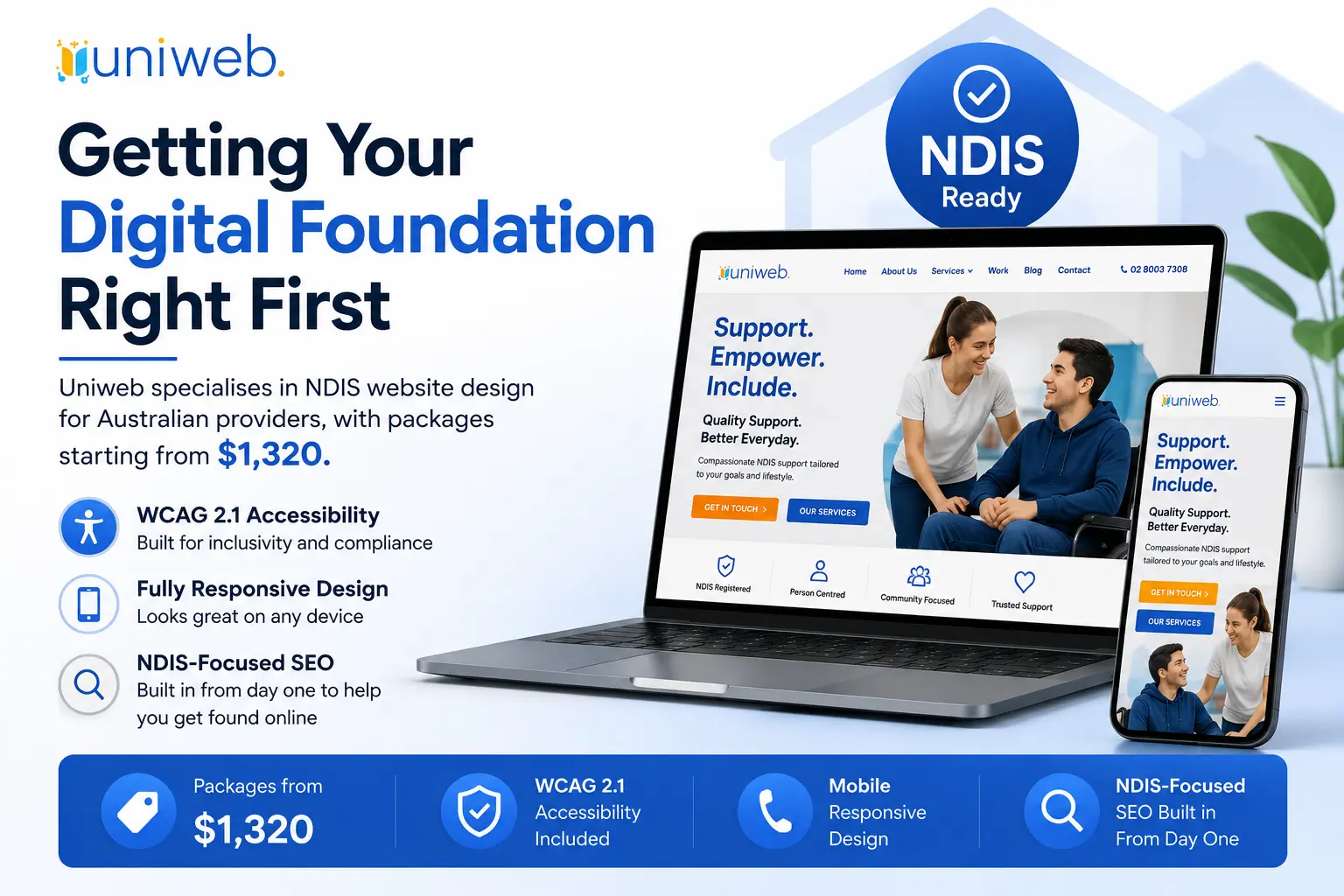
Uniweb specialises in NDIS website design for Australian providers, with packages starting from $1,320. All packages include WCAG 2.1 accessibility features, fully responsive mobile design, and NDIS-focused SEO built in from day one. Whether you’re a new provider or an established organisation looking to refresh your online presence, a purpose-built NDIS website provides the highest return on investment before you layer in additional AI tools.
You can also explore Uniweb’s hosting and maintenance plans to keep your site fast, secure, and up to date — or get in touch to discuss your digital goals with the team. To see examples of completed work, visit the website portfolio, or read what clients say on the testimonials page.
Ready to Modernise Your NDIS Digital Presence?
Explore Uniweb’s specialist NDIS website packages — built for Australian providers, priced transparently, with no lock-in contracts.
View NDIS Website Packages →